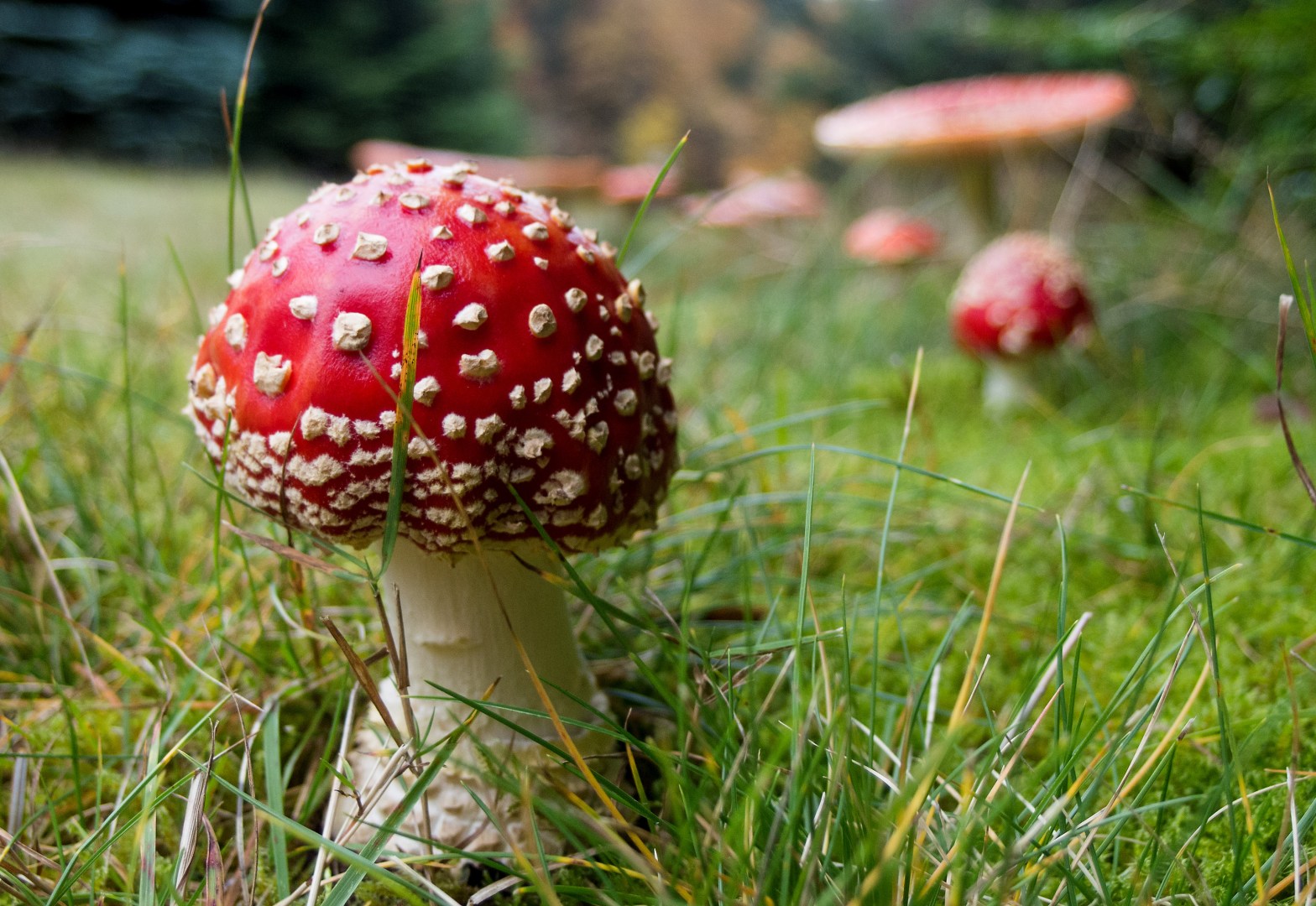
In recent years, an obscure chemical compound has taken social media by storm. Psilocybin, the primary psychoactive agent in « magic » mushrooms, has emerged from the shadows after a series of clinical trials with truly incredible results. On one hand, proponents of psychedelic freedom see it as a sign of a future revolution in human consciousness, while the medical community sees potential for treating depression and addiction. What does science say?
Throughout history, psilocybin has sparked the most hallucinatory debates. Researchers like ethnobotanist Terence McKenna and Paul Stamets in the United States argue that humans may have co-evolved with hallucinogenic mushrooms. According to the Stoned Ape theory coined by Terence McKenna in the book « Foods of the Gods, » the transition from Homo erectus to Homo sapiens 100,000 years ago was allegedly caused by the regular consumption of Psilocybe cubensis. Incidentally, this mushroom is now the world’s primary source of psilocybin.
The psychedelic revolution
While the debate rages on among archaeologists and mycologists, partly due to the difficulty of relying on organic compounds dating back so far, psychedelic mushrooms have indeed caused a revolution: that of the sixties…
In 1938, American researcher Roberts Evans Schults became the first contemporary Westerner to witness the power of the mushroom. Later, the amateur mycologist « discovered » the mushroom among the Mazatecs in the Oaxaca region of Mexico. In 1955, banker and amateur mycologist Gordon Wasson and his wife met a shamanic priestess, Sabina, who introduced them to the mushroom. Gordon described the experience in an article for the Times, thus initiating the wave of psychedelic tourists to Mesoamerica.
Swiss chemist Albert Hofmann successfully isolated psilocybin from the Psilocybe mexicana mushroom in 1958. Hofmann was already famous for synthesizing LSD in 1938. At the time, research on psychedelic substances focused on Mesoamerica, still colored by the colonial prejudices of the early Spanish conquistador accounts. Initially, anthropologists and later American and European ethnobotanists began to explore the daily lives of indigenous peoples from Mexico to the Amazon, noting the use of substances like ayahuasca and peyote.
Timothy Leary, still a researcher at Harvard, tried the mushroom in Mexico, returned to the university as a changed man, and founded the Harvard Psilocybin Project. This was followed by a decade of wild experimentation. In laboratories, American universities (sometimes aided by the CIA) synthesized and tested new chemical compounds. In just a few years, these new drugs hit the streets. The sixties are the children of a mushroom from Mexico.
What is psilocybin?
Psilocybin is the primary psychoactive agent in the Psilocybe genus of mushrooms, which encompasses over 200 species. Psychedelic mushrooms (containing Psilocybin) come in various sizes, typically featuring light beige to off-white caps and white to brown stems, sometimes with a bluish tint. One commonly studied species is Psilocybe cubensis; within this species, the « Golden Teachers » subspecies is highly prized for its imagination and sense-enhancing effects.
Among the most popular and commonly used magic mushrooms in the United States and Europe, those containing psilocybin play a significant role, having an ancient history in spiritual and religious rituals. As the primary active compounds in the fly agaric mushroom (not to be confused with Psilocybe cubensis), you find muscimole, ibotenic acid, and muscarine. Contrary to common assumptions, it’s not psilocybin that holds the central position as the psychotropic element but rather muscimole.
How does psilocybin act on the body and mind?
It is psilocin that is responsible for the hallucinogenic effects of the psilocybe mushroom. Although there are several ways to consume the mushroom, the effects typically last from three to six hours and are divided into four stages: ingestion, onset, peak, and return. Upon ingestion by humans, psilocybin is metabolized by the body to create psilocin through a dephosphorylation process.
Hallucinations usually begin after 30 minutes but reach their peak after two hours. These may include powerful visual hallucinations, a distorted sense of time and reality, heightened flow of ideas, and a profound amplification of emotions.
Interestingly, many have described their experience as a dissolution of the ego, characterized by the breaking down of the boundary between oneself and the world. People often speak of a memory of being born, a lasting sense of wonder, and a divine experience. In one of the most cited studies, over 80% of participants described the experience as one of the five most important experiences of their lives.
What science says
The effects of psilocybin on the human brain are measured by their impacts on certain neurotransmitters. Recent research has identified a neurotransmitter that is particularly susceptible to psilocybin: the serotonin 5-HT2A receptor. This receptor plays a key role in cognitive processes. Many mental disorders are directly linked to the « 2A » receptor. Serotonin, on the other hand, plays a crucial role in regulating emotions. After a single intake of psilocybin, these neurotransmitters may become more sensitive to certain electrical signals, potentially reducing pain signals and aiding in emotional regulation.
The landscape of psilocybin research is currently vast, with over 1000 studies conducted so far. Among these studies are approximately 27,000 other studies on hallucinogenic drugs as part of a global body of research. The study that arguably caused the most stir about psilocybin dates back to 2006. A significant study in 2006 led by Roland Griffiths and his team at Johns Hopkins University, titled « Psilocybin Can Induce Mystical-type Experiences, » played a pivotal role in this trend.
The study focused on individuals interested in spirituality who had never tried psychedelics before, examining the effects of high doses of psilocybin. The results showed that psilocybin reliably induced mystical experiences similar to those historically reported by mystics. Participants described these experiences as deeply personally and spiritually significant. These mystical experiences are closely linked to the enduring benefits reported in various studies, characterized by positive emotions, a sense of unity, and a renewed sense of life’s purpose.
Since then, much research has measured the benefit of incorporating psilocybin into already established therapies. In terms of corroboration, the therapies where psilocybin has shown the most effectiveness include:
Treatment against depression
- Study by Roland Griffiths et al. (2016): At Johns Hopkins University, this study led by Roland Griffiths and his team will analyze the consequences of psilocybin regarding depression observed in individuals with cancer. Notable and lasting improvements in the mood and quality of life of patients have been observed through controlled administration of psilocybin, as published in the « Journal of Psychopharmacology. » Following the treatment, a finding is made: the effects continue to manifest for a period of six months, suggesting the possibility of a prolonged influence of psilocybin on depression. It is worth noting that the duration of the therapeutic effect and the absence of relapse are, by the way, crucial aspects in the research on effective therapies for depression.
- Study by Carhart-Harris et al. (2018): The exploration of the effects of psilocybin on treatment-resistant depression was undertaken by Carhart-Harris and his team at Imperial College London. Published in the « Journal of Psychopharmacology, » the study revealed that depressive symptoms in patients resistant to conventional treatments could be significantly alleviated by psilocybin. Neurological changes, potentially promoted by psilocybin, were revealed by the results, which could enhance mood.
2: Treatment against PTSD
- Study by Mithoefer et al. (2018): In their study led by Mithoefer and his team, the evaluation of the effectiveness of psilocybin in treating post-traumatic stress disorder (PTSD) was conducted. Psilocybin, combined with psychological therapy, demonstrated a significant reduction in PTSD symptoms among veterans, as reported in « Psychopharmacology. » The beneficial effects persisted consistently over an extended period of several months.
- Study by Ot’alora et al. (2018): A study on the use of psilocybin to treat PTSD in women was conducted by researchers, including Ot’alora. Significantly, the results indicate in « Psychopharmacology » that PTSD symptoms can be reduced by psilocybin, thereby improving the quality of life. Participants, after receiving a single dose, reported enduring improvements over time..
3: Treatment against addiction
- Study by Bogenschutz et al. (2015): Regarding the treatment of alcohol dependence, Bogenschutz and his team examined the use of psilocybin. Publishing its results in the « Journal of Psychopharmacology, » the study states that psilocybin is capable of aiding in the reduction of alcohol consumption and maintaining benefits over an extended period.
- Study by Dakwar et al. (2014): For the treatment of tobacco dependence, several scientists, including Dakwar, conducted research on the use of psilocybin. Published in the « Journal of Psychopharmacology, » the results showed that psilocybin is effective in reducing cravings to smoke and promoting successful smoking cessation among participants.
Legalization
In both Canada and the United States, psilocybin is classified as a drug with no medical benefit and is therefore subject to complete prohibition by authorities. Thus, psilocybin and its derivative psilocin are internationally controlled under the United Nations’ Drug Control Conventions and, in Canada, under the Controlled Drugs and Substances Act (CDSA).
However, in light of the remarkable medical findings, some American cities and even states are beginning to lift the ban. Consequently, Denver and Oakland are reported to have become the first two cities to decriminalize magic mushrooms. The measures implemented put an end to investigations and penalties related to the possession of entheogens such as certain hallucinogenic mushrooms, certain cacti, and the iboga plant.
In Canada, psilocybin is still on the list of prohibited substances. In January 2023, Health Canada approved the use of psilocybin for therapeutic purposes under its Special Access Program. The Roots To Thrive clinic in British Columbia became the first healthcare center in the country to legally offer group therapy with psilocybin.
Shortly after, in May 2022, the first patient in Quebec was treated with psilocybin. However, any other consumption in Canada, including microdosing, remains prohibited. Microdosing involves taking tiny doses on a strict schedule for periods of several months. Highly popular in Silicon Valley, the practice is notably endorsed by some American podcasters and personalities.
Psilocybin : an old companion?
If public imagination quickly ignited regarding the magical molecule, it is partly because it taps into a cultural archetype as old as the world. Cave paintings dating back over 9,000 years in Tassili N’Ajjer, Algeria, depict a shaman in the midst of a dance ritual, hands laden with mushrooms, in what seems to be a technique of ritual ecstasy.
For ethnobotanist Terence McKenna, it was evidence that civilization had been strongly influenced by the magical molecule. Although this theory is heavily criticized (are we really certain these are hallucinogenic mushrooms?), numerous representations of the mushroom are scattered across Mesoamerica. In Guatemala, anthropomorphic mushrooms over 3,000 years old have also been associated with the psilocybe genus.
American classics researcher and specialist Carl A.P. Ruck theorized in his work « The Cult of Mithras and the Mushroom » that hallucinogenic mushrooms played a central role in one of the most famous initiatory societies under the Roman Empire, a theory that has also been applied to the mysteries of Eleusis.

One of the oldest cave paintings shows a man adorned with mushrooms. For American ethnobotanist Terrance McKenna, there’s no doubt: psychedelic mushrooms facilitated the transition from Homo erectus to Homo sapiens.
« If you die before you die, you don’t die when you die. » Quote from the Monastery of Saint Paul, taken from Brian Muraresky’s book on ancient initiation rites.
It has been called the Holy Grail, the elixir of long life, ambrosia. Every culture has had its myths about a divine particle that makes one equal to God. Western civilization is so steeped in this notion that we tend to forget that drugs accompanied the beginnings of religion, stimulated the adoption of agriculture, and funded the modern state.
« Drink, for this is my wine, » a phrase that was the motto of the West for a thousand years, is not so distant from an ancient saying about Bacchus, the Greek God of madness and fertility. Drinking Bacchus’ wine, in the Greek imagination, meant becoming Bacchus himself. Long before the Greeks, the Rig Veda described soma, which makes one forget all troubles and renders god-like. In Zoroastrian tradition, there is the huma, an almost exact counterpart to soma.
If you die before dying, you don’t die when you die
Quote from the Monastery of Saint Paul, taken from Brian Muraresky‘s book on ancient initiation rites.

Pierre-Olivier Bussières is the Editor-in-Chief of Hoppy History and Uber Optimized. He is the Sales and Marketing Director at Uberflix Studio. He also writes about travel, geopolitics, and alcohol markets, and has published articles in The Diplomat, Reflets, The Main, Go Nomad, Global Risk Insights, and Diplomatie.


Laisser un commentaire