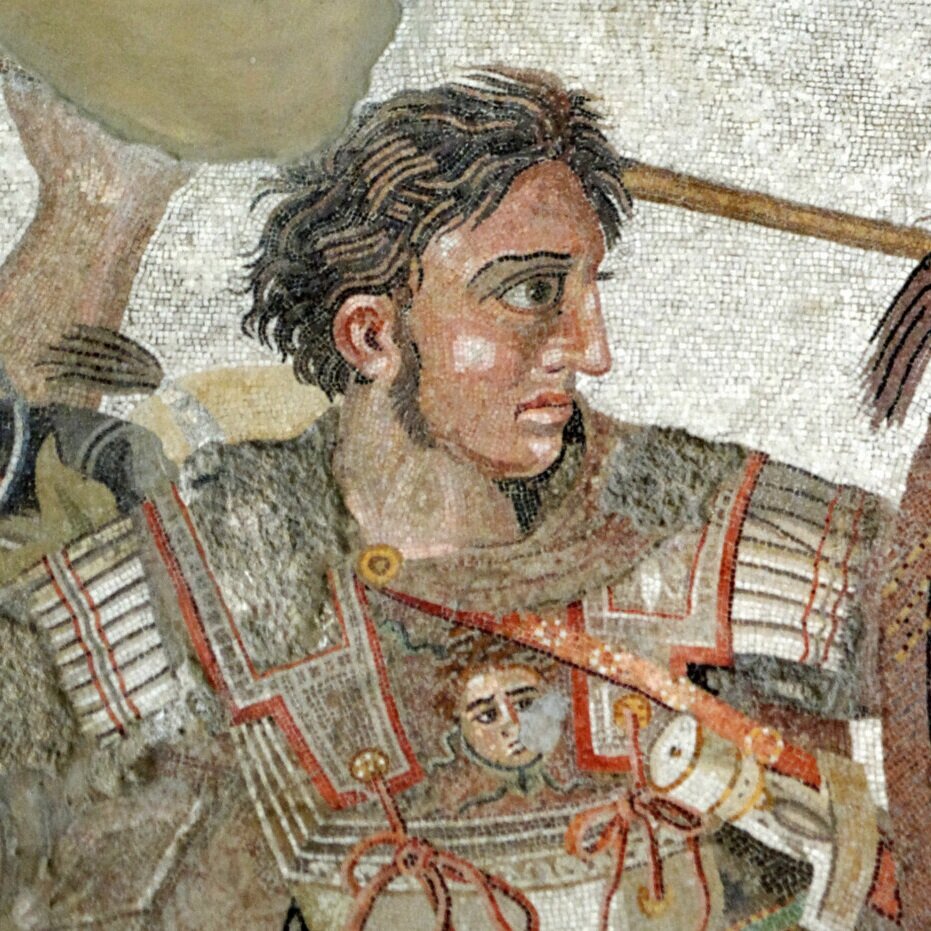
Alexander the Great is one of the greatest names in history. He fascinates historians and inspires leaders. Visionary, modern, magnificent, fearless, and courageous, Alexander is often considered a model of military and political strategy. Less talked about, however, is Alexander the Great’s love of banquets, parties, and good wine.
Macedonia: « No Country for Water Drinkers«
First of all, it’s essential to clarify to avoid any confusion: Alexander wasn’t Greek; he was Macedonian. This made a huge difference, as Macedonians had been mocked by Greeks for centuries because of their accents and customs. It wasn’t exactly a love story between Greeks and Macedonians. They looked very much alike, but the Greeks were prodigiously racist and considered anyone who didn’t speak Greek to be a barbarian, i.e., they went « ba ba ba. »
However, Macedonians did speak Greek. They worshiped the same gods, spoke the same language, and read the same philosophers. One of the greatest Greek authors, Euripides, even found refuge in Macedonia because he didn’t feel sufficiently appreciated at home in Greece.

In the time of Philip II, father of Alexander the Great, Macedonia had a great admiration for Greece. The children of the aristocracy were educated in Greek, and Greek was used at important meetings.

It’s important to mention one crucial point: Dionysus. This god is often depicted with laurel wreaths and resembles Jesus. Dionysus is the god of folly, fertility, earth and just about anything else that makes you blush. He’s also the god of wine. The Greeks, like the Macedonians, had this strange idea that when you drink wine, you become Dionysus. In other words, when you drink wine, you become divine. Dionysus was therefore the official sponsor of feasts, festivals and banquets. In Macedonia, banquets were taken very seriously. Drinking in honor of Dionysus took place everywhere and in every situation.
For the Greeks, wine is not just a drink, it’s an identity. It was synonymous with civility, common sense and virility. Drinking wine without showing that you’re drunk represents the pinnacle of masculine identity. Those who can drink a lot without appearing drunk are respected. Even one of history’s most famous philosophers, Socrates, was renowned for his ability to drink all night.
For the Greeks, wine wasn’t just a drink, it was an identity. It was synonymous with civility, common sense and virility. Drinking wine without showing that you’re drunk represents the pinnacle of masculine identity. Those who can drink a lot without appearing drunk are respected. Even one of history’s most famous philosophers, Socrates, was renowned for his ability to drink all night.
Oaths were also taken on alcohol. Those who abstained from alcohol were ridiculed, marginalized and not trusted. They were called « water drinkers ».
Philip the Second: fighter, diplomat, and hardcore drinker
But where does Macedonia fit in the picture? Macedonia is a small country, weak and surrounded by enemies, fragmented and fragmented. To understand this, you need to know that Macedonia has enormous strategic advantages: vast fertile plains, plenty of woodland and mineral deposits. Just to the south, Greece is predominantly mountainous, with almost no forests and very little ore. Everyone around Macedonia is trying to grab its riches. As Macedonia is made up of small rival kingdoms, it’s almost always war, just like in Greece.
Alexander’s father, Philip II, inherited the crown when his brother died at the age of twenty, a difficult period. However, the young king quickly succeeded in creating a veritable empire thanks to his dazzling successes.

Firstly, Philippe changed the game by creating a professional army. One of his greatest achievements was the creation of a loyal, professional army. Philip is brilliant. He understands that Macedonia cannot afford to have professional soldiers armed to the teeth. So he recruited peasants and farmers and gave them a huge spear, called a sarissa, about 5 meters long.
These soldiers form compact formations and advance towards the enemy. They are like tanks. No one can stop them. Even if the first spear is broken, there are four more ready to impale you in a whirlwind of screams and external bleeding.
Secondly, Philippe is fully committed to diplomacy. Through embassies, banquets and hostage-taking, he succeeded in gathering many of the most important personalities of the time under his tent, which considerably strengthened his legitimacy in the eyes of the Macedonians and Greeks.
Thirdly, Philip II used the diplomacy of marriage. Philip married at least seven wives, which should come as no surprise, since polygamy was commonplace in his family. The goal is to create alliances with distant regions, former enemies and potential sponsors for his wars.
Banquet diplomacy…and court jealousies
One of these women was Olympias. It seems that Philip II sincerely loved Olympias, but things turned sour when he started getting involved with other women. By the time Alexander was born, their relationship had been poisoned. They deeply hated each other, and Olympias began to fear for her life. As a foreigner, she was not appreciated by the Macedonians, who believed she had magical powers.
She belonged to a secret society as a priestess of Orpheus, a cult of Dionysus. Olympias also charmed snakes and often walked around with one or two garlanded snakes around her. She even slept with snakes in her royal bed. The situation deteriorated for Philip, who had a phobia of snakes. One day, upon entering the room, he saw Olympias with a snake in her bed, which literally made him lose his head.
However, it’s essential to note that Olympias was a powerful, intelligent, and well-connected woman. Her most valuable asset was her son, Alexander.
Alexander’s father was a functional alcoholic with hundreds of enemies who wanted him dead. Philip II was an absent mother who was at best indifferent, and at worst extremely stern. His mother, Olympias, was paranoid, saw plots against her everywhere, and tried to turn Alexander against his father. She told him that he was the son of Jupiter, the most important god. From childhood, Alexander’s ambitions for greatness were immense, his parents’ expectations impossible to fulfill, and he found himself caught between two parents who despised each other.
Hammered by dreams of greatness, Professor John Maxwell O’Brien of Queen’s College, City University, New York, concluded that Alexander frequently turned to the bottle to dilute his feelings of inferiority and anxiety. He is the only historian I’ve found who refers to Alexander as an alcoholic: classical authors tend to want to defend Alexander the Great by saying that there is no definitive proof. On the other hand, you have to give Caesar what he deserves. In Macedonia, everyone drank wine, especially at banquets in the capital, Pella.
After hunting and training, the banquet was a veritable institution. It was not a 5 à 7 like we poor moderns. A proper banquet could last three days. It was an eloquence contest, an important morale-boosting party, a kind of carnival where people said things they wouldn’t otherwise say, AND it was also a drinking party. Being drunk was not only allowed, it was encouraged. In fact, in the eyes of this macho bunch, the problem wasn’t so much being drunk as looking drunk.
Drinking was a matter of honor. The Greeks, who thought they were better than everyone else, often mocked the Macedonians for drinking their wine undiluted. They regarded them as Barbarians. And according to Alexander’s biographers, it seems that the Macedonians often did drink their wine without mixing it with water.
And that could be a problem. Classics professor Carl A.P. Ruck in the U.S. believed that the Greeks put powerful hallucinogenic drugs in their wine, including belladonna, henbane, datura, and mandrake. Keep this in mind, as it may explain the celebrations we’re about to talk about…
A potentially momentous event occurred when Philip married a general by the name of Attalus. On the wedding night, Philip II held a banquet. Olympias was furious, but Philip II didn’t care because he was the boss. So, they threw a banquet and drank like pigs.
They made endless toasts. Alexander also toasted and had a few glasses up his nose. Suddenly, General Attalus took the floor, made a great speech, and said, « At last, Macedonia is going to have a real Macedonian prince born of a real Macedonian woman. » Alexander stood up, threw his glass at Attalus’ head, and said, « Are you insinuating that I’m a bastard? »
Everyone started insulting each other, and a fight was narrowly avoided. But Philip II wasn’t happy. He pulled himself up on a couch and asked his son to mind his own business. The war between father and son began. Alexander was almost exiled. Philip II never wanted to see his son again. Discreet negotiations for the prince’s return took place immediately, but from then on, the relationship between father and son was icy.
During another drunken evening, Philip was assassinated. Alexander was proclaimed king and finally turned his attention to the most formidable enemy of the age, Darius, king of the Persians. Alexander had been dreaming of glory since he was a boy, and now he was at the head of a 50,000-strong army to attack the largest empire of the age: Persia.
Who’s idea was it to burn down Persepolis?
After three dazzling assaults on Persian troops, Alexander the Great finally entered the Persian capital: Persepolis. It was an incredibly rich city in the middle of the desert, built solely to house the king of kings. Grandiose, magnificent, and glorious, Alexander’s entrance was triumphal, and as a bonus, he discovered the most gigantic treasure of the time in the city, equivalent to around one hundred tons of pure silver, or 120,000 silver talents, a kind of ingot weighing 28 kilos of pure silver.
But that was Alexander’s perspective. From the people’s view, things were not going so well. After having prevented his troops from pillaging the fortified cities of Gaza and Tyre, Alexander this time granted them the right to plunder without restriction for a whole day. For the population, it was total horror: looting, gang rapes, gratuitous murders. It was not a good day for Persepolis.
Like his father Philip, Alexander enjoyed organizing sumptuous banquets during military campaigns. So, the amphorae of wine were brought out and the party began. At one point, one of the Greek courtesans following the army got excited and talked about burning Persepolis. The Persians had burned Athens, Greece’s most important city, so she said, « Wouldn’t it be nice to avenge Athens by burning Persepolis? » According to Plutarch, Alexander replied, « OK, let’s do it », and descended on the streets of Persepolis, setting everything on fire.
However, there was a small caveat. Serious historians, unlike myself, believe that the destruction of Persepolis was premeditated. Alexander saw the city as the ultimate symbol of Greece’s enemy, and as a vengeful Greek hero, he would have wanted to destroy the capital to show once and for all that Persia was finished.
What everyone agrees on is that Alexander and his army couldn’t care less about Persepolis. The city was in the middle of the desert, it was no use to the Macedonian army as they already had an economic capital in Persia, Babylon. Besides, Persepolis represented all the vain glory of the fallen king.

Fighting hangover
The bulk of the fighting was over. Persia was defeated at long last. The troops were tired, and eager to get home, believing their campaign at ended in utter triumph. Yet there was no sign of turning back. We could hear rumblings in the Macedonian tents, as soldiers started expressing their dissatisfaction. Alexander himself was now becoming alien. He was turning native. He took foreign wives, acting like the king of Persia himself, and even sympathized with the enemy.
Adrian Goldsworthy writes « Many Macedonian aristocrats were very uncomfortable with the way Alexander adopted the Asiatic dress, harem, eunuchs, and ceremonial of the Persian court. They resented him for appointing former enemies to important and honorary positions. »
As Alexander sinks deeper and deeper into vast Asia (insert quotation marks), he sinks deeper and deeper into paranoia. There are more and more quarrels with his comrades, and it seems that his drinking becomes more and more excessive. O’Brien says that in the last years of his life, Alexandre becomes increasingly paranoid and unpredictable. Alexander already had an excessive and impatient temperament.
Historians believe this moment when Alexander became megalomaniacal, violent, and unpredictable. According to Adrian Goldsworthy: « Whenever he had the opportunity, Alexander organized one of those drunken banquets he and his father were so fond of, as was the case with the Macedonian aristocracy in general. However, occasions arose much more frequently during the lulls between campaigns, accentuating the difference between these rare intervals and the normality of marching, fighting, and killing. »
A Fatal Drunken Fight
An evening of drinking ended tragically when Alexander shot through and through one of his generals, Cleitos. Cleitos was one of Alexander’s closest and most loyal officers, often referred to as Cleitos the Black because of his dark skin.
The incident took place at a banquet in Samarkand, Sogdiana (now Uzbekistan). Alexander and his generals were celebrating their recent victories in the region. The atmosphere was festive and the alcohol flowed freely. Throughout the evening, the men began to discuss Alexander’s achievements and the importance of his command.
As the conversation progressed, Cleitos criticized some of Alexander’s decisions, notably his tendency to adopt Persian customs, which had been frowned upon by some Macedonians.
The discussion quickly degenerated into a violent argument. Cleitos accused Alexander of favoring the Persians at the expense of his fellow Macedonians. In return, Alexander, intoxicated and irritated by the criticism, allegedly threw a javelin at Cleitos. The javelin mortally wounded him, killing him instantly.
The worst party in History
However, the most shocking story is that of the funeral of his friend Calanus, an Indian sage who had accompanied the army for two years. On his death, Alexander the Great organized a contest « to determine who could drink the greatest quantity of unmixed wine ». According to Chares of Mytilene, 35 people died before midnight, and a further six from various complications in the days that followed.
The winner himself did not survive more than four days after the event. Promachos, who drank an impressive 13 liters of wine, received the prize. The wine was Macedonian, which means it was likely diluted a bit less than its greek counterpart. For his « heroic » efforts, Promachos received the prize, only to die three days later, also of alcohol poisoning.
How did Alexander the Great Die?
One evening in June, after drinking an entire amphora of pure wine, the so-called « chalice of Heracles » (over 5 liters of pure wine), Alexander suffered severe back pain. A sharp pain, as if a spear had pierced him, followed by nausea. Soon afterwards, feeling better, he started drinking again. After a day of enforced rest and a cold-water bath to help cope with the fever that had taken hold of him in the meantime, Alexander attended a symposium at the Mediacs and got drunk in an attempt to quench his infernal thirst.
In the days that followed, with his temperature rising, he attempted to perform his royal duties, but on the 24th of the month of Desio (in the Macedonian calendar, this corresponds roughly to June 9), his condition worsened and he was bedridden. The following day, he first lost the ability to speak, then his consciousness, until the 28th of Desio, and finally died in the evening.
Alexander the Great’s death triggered typical reactions to the loss of a celebrity. People wept and shaved their heads, while the most devoted admirers starved themselves to death, at least according to the sources that have come down to us, all of which are likely to exaggerate the event for political reasons.
Alexander, a brilliant general, a wise leader and at times magnanimous towards his subjects and enemies alike, was a superstar of the Ancient World. However, his swift and tumultuous life was overshadowed by self-destruction, a sad reality shared by many celebrities throughout history. The world thus said farewell to Alexander the Great, an icon of antiquity marked by his self-destructive nature.
Sources
- Adrian Goldsworthy (2023) Alexandre et Philippe, Perrin
- Bosworth, A. B. (1988). Conquest and Empire: The Reign of Alexander the Great. Cambridge University Press
- Hammond, N. G. L. (1980). Alexander the Great: King, Commander, and Statesman. Bristol Classical Press
- Green, P. (2013). Alexander of Macedon, 356-323 B.C.: A Historical Biography. University of California Press
- Worthington, I. (2004). Alexander the Great: Man and God. Pearson Education
- Stoneman, R. (1991). Alexander the Great: A Life in Legend. Yale University Press
- Wheeler, M. (2008). Alexander the Great: The Invisible Enemy – A Biography. Routledge
- Waldemar, H. (2004). Alexander the Great: The Story of an Ancient Life. Routledge.
- Billows, R. A. (2008). Alexander the Great in Fact and Fiction. Oxford University Press
- Carney, E. D. (2010). Olympias: Mother of Alexander the Great. Routledge.
- Austin, M. (2009). The Hellenistic World from Alexander to the Roman Conquest: A Selection of Ancient Sources in Translation. Cambridge University Press.
- Simon Denison (1992) Was Alexander the Great an Alcoholic?, The Independent
- DI Che Ci Bo (2020) The Fatal Drunkedness of Alexander the Great, Di Che Ci Bo,

Pierre-Olivier Bussières is the Editor-in-Chief of Hoppy History and Uber Optimized. He is the Sales and Marketing Director at Uberflix Studio. He also writes about travel, geopolitics, and alcohol markets, and has published articles in The Diplomat, Reflets, The Main, Go Nomad, Global Risk Insights, and Diplomatie.


Laisser un commentaire